04 April 2015

A Meditation on Love for Resurrection Day


Paul's definition of love in 1 Corinthians 13 takes on a new light when considered during the Passion Week.

Love is patient and kind.

There are perhaps no two words that better describe the Christ.  Even when He spoke hard truths about repentance, He was compassionate.  Even when He rebuked, his sternness came from the kindness that is intended to lead us to repentance (Rom 2.4).  Out of love for His enemies, He came to make Himself available to human souls floundering in the hopeless sea of sin.

That required patience when we were arrogant and unresponsive.

That kind of patience required a divine, purposeful kindness.

Love does not envy or boast. 

Jesus' earthly ministry was fraught with frustrations.  He was rejected in His hometown.  He had no place to lay His head.  The Jewish leaders heckled Him whenever they could find the occasion.  People cared more about the miracles He worked than the words of truth He spoke.  His own hand-picked followers would desert Him in the hour He was forsaken by His own Father.

Instead of wishing for better fortunes, Jesus shouldered the cross.

Jesus' earthly ministry was also marked by incredible success.  Demoniacs were cured.  Men whose hearts had been hard gradually softened to the truth.  Dead were raised and entire families believed.  Eleven men who often seemed so clueless would go on to personally carry Jesus' message and lead thousands of men and women to salvation.  Though He certainly had the right to boast in His accomplishments, Jesus chose instead to direct the glory to His Father in heaven.  Though He never told anyone who worshiped Him not to do so, Jesus was not like the false messiahs and prophets who wanted to make spectacles of themselves and attract large crowds of followers.

Instead of becoming prideful, Jesus deferred to His Father's will.

Love is not arrogant or rude.

Isaiah prophesied that the Messiah would be silent before His accusers in the same way a "sheep before its shearers is silent," and He would not open His mouth in self-defense (Isa 53.7).  In the greatest display of humility the world has ever seen, Jesus endured the false accusations and the beatings and the shame and the rejection, never once putting His accusers in their places the way He justly could have done.  In the moment that He corrected Pilate, reminding the Roman Governor that he had no authority over Jesus except what had been given him from Heaven, Jesus revealed His meekness.  He had power and authority -- infinite power and authority.  But to accomplish the redemption of humanity, He had laid those things aside and would humble Himself to the point of death on a cross.

Were we in Jesus' place, most of us would have flexed a little muscle.  Jesus' demonstrations of His power weren't intended for that purpose.

Love does not insist on its own way.

In the garden, Jesus revealed His humanity in the struggle to submit to His Father's will.  And yet, despite the natural trepidation, He did not insist on His own way, choosing instead to repeatedly say, "Not my will, but yours."

No matter what adjectives we use to describe love, true love always involves sacrifice.  True love always means putting someone else first.  After all, there can be no greater sacrificial act than to lay down one's own life for someone else (John 15.13).  In Jesus' case, that meant putting all of human history before His own wants and needs -- before His own divine right to honor and glory and well-being.  That kind of love is rooted in the genuine desire to sacrifice for someone, a motivation to meet another's needs at any cost.

In modeling that kind of love, Jesus demonstrated that we shouldn't show love simply because it's the right thing to do.  We should be compassionate and empathetic and sacrificial because we desperately want to.  John captures it best: "By this we know [can understand, experience, and emulate] love, that he laid down his life for us, and we ought to lay down our lives for the brothers" (1 John 3.16).

Love is not irritable or resentful.

With the betrayer's kiss still warm upon His cheek, Jesus called Judas "friend."  This came after three years of knowing the man's character, knowing that he stole from the poor (John 12.6), knowing that he would ultimately be a dagger in the back.  Any one of us who possessed such condemning knowledge would have stored up three years' worth of bitterness against that person and prepared a delicious, cutting response.  Actually, any one of us would probably have taken the appropriate actions to bring that person to justice long before he or she had the opportunity to do any harm.

Jesus, however, turned the other cheek -- in a sense, literally: he accepted the traitor's kiss on one cheek, and then bared the other for the insults and accusations that were soon to follow.

Love does not rejoice at wrongdoing, but rejoices with the truth.

Matthew 9.36 records that Jesus was deeply moved with compassion for the Jewish people, because "they were harassed and helpless, like sheep without a shepherd."  He desperately wanted for the people to know grace and forgiveness.  He wanted to communicate truth and love to them.  This kind of compassion motivated Him at every turn of His three-year ministry.

On two occasions, Jesus overturned the tables and drove the moneychangers out of the temple courtyard in Jerusalem.  Instead of keeping the temple as "a house of prayer for all the nations" (Isa 56.7), the Jews had turned it into a "den of thieves" (Jer 7.11) -- restricting the Gentile worshipers to the outer court, charging exorbitant fees for sacrificial animals, and making interest hand over fist on the exchange of currency.  They knew no love for the expansion of truth -- only the love of profit.

Jesus cared only that His Father's house function as it was intended: a place where sins were confessed, glory was given to God, and people of all nations could worship.  He did not rejoice at the wrong that the Pharisees and religious leaders were doing in the temple, even though there was a constant flow of traffic through the temple mount.  In that regard, I'm reminded of the unfortunate reality that pastors and teachers can fall into the trap of caring only about attendance -- packing pews by any means necessary, caring more about the building's upkeep than the state of its congregants' hearts.  Successful ministry is not based on numbers.  The Pharisees certainly thought in those terms, and in so doing, they trained themselves to rejoice in the wrong they were doing.

By contrast, Jesus proclaimed only truth.  He was truth (John 14.6).  God was willing to forgive any who would come to Him.  For that purpose, He had sent His own Son -- the Lamb of God -- to take away the sins of the world.

Love bears all things, believes all things, hopes all things, endures all things.

Christ's unwavering perseverance, His commitment to the divine mercy mission, would lead Him to endure a shameful, agonizing death on the cross.  Though He feared His Father's wrath -- a wrath perfect in its holiness, a punishment Christ Himself did not deserve -- Jesus believed in the Will of His Father.  For that reason, He went willingly to the cross, "despising the shame" (Heb 12.2), and surrendering His life of His own volition (John 10.18).

In a very real sense, Jesus bore and endured all things on our behalf: the greatest pain and suffering imaginable -- not the cross, but the very weight of every human soul condemned to eternal judgment. He became sin for us and bore an eternity's worth of punishment on our behalf.

We should bear the burdens of others and forgive wrongs done against us because that's exactly what Jesus did on our behalf.

Love never ends.

And this -- this is victory.  His and ours.

Jesus Christ has overcome the grave.  For now and for eternity, the soul and the body are free indeed if they are found in Him.  Lacey Sturm wrote, "Death has died and love has won," and this is the truth believers celebrate year-round, though we especially remember it at Easter: that Christ's sacrifice was sufficient to satisfy the wrath of a holy God, that our debt of sin was credited to His account and paid in full, and that there is no longer any condemnation to be found in those who are called His children (Rom 8.1).

In Christ's resurrection, I too am free of death.  The grave will not be my final home.

In Christ's unending love, I am free of sin.  No longer am I separated from my Father.

Praise the Lord for His unmerited favor!  There is nothing more I owe.  And so I give Him everything.

There can be no greater way of celebrating.

~*~

14 March 2015

Rogue One: Looking Backward to Look Forward

Wedge Antilles - Rogue Squadron: The Rebel Opposition (Dark Horse Comics)

Since Thursday, I have been soaking up any details I can find about the first official spin-off movie set in the Star Wars universe (not counting The Clone Wars). [UPDATE #1: these "spin-off" movies will officially be categorized as Star Wars "Anthology" films]  Rumors abound, but what is official is that "Rogue One" will begin filming in London this summer and is slotted to be released December 16th, 2016.  The official release from StarWars.com is as follows:
Rogue One is the title for the first film in a unique series of big-screen adventures that explores the characters and events beyond the core Star Wars saga.  Rogue One will be directed by Gareth Edwards (Monsters, Godzilla) and written by Oscar nominee Chris Weitz (Cinderella, About a Boy, Antz).  The first actress cast is Felicity Jones, who garnered an Academy Award nomination and critical acclaim for her performance in The Theory of Everything.  The idea for the story of Rogue One came from John Knoll, an Academy Award-winning visual effects supervisor and chief creative officer at Industrial Light & Magic. [full article here]
UPDATE #2: Gareth Edwards has revealed that the film "will revolve around a rogue band of resistance fighters who unite for a daring mission to steal the Death Star plans and bring new hope to the galaxy." [full article here]
To some degree, I wish this news of "Rogue One" hadn't come until after Episode VII's release, simply so I could know exactly how I should feel about it.  Any excitement I feel for either of these releases is tempered by a healthy caution, although the intensity is even greater for "Rogue One," simply because Rogue Squadron is my absolute favorite aspect of Star Wars -- movies, videogames, novels, or otherwise. My criticism for this release will be perhaps even harsher than that of "The Force Awakens."

In some sectors, referencing Star Trek in a blog about
Star Wars is a violation of intergalactic law.
Putting aside my feelings for the movie itself, however, I am absolutely thrilled that Michael A. Stackpole, one of my favorite authors, was justly credited by bloggers for the instrumental role he played in creating Rogue Squadron.  His influential series of novels and comic books featured the daring Rogues in their exploits against the remnants of the Empire following the events of Return of the Jedi.  These works shifted the focus of Star Wars away from the big heroes, lightsaber battles, and tyrannical Sith Lords to center instead on the pilots in the cockpits of snub fighters.  Stackpole's characters were the everyday men, women, and aliens who comprised the ranks of the New Republic military, but each was unique and integral -- not just red-shirted drones existing for the purpose of creating the illusion of the main characters'  mortality.  It was his attention to the reality of how squadron mates would truly interact, coupled with his unique focus on the internal political strife of Imperial command in the wake of Palpatine's death, that made the X-Wing stories so memorable.  Aaron Allston's later partnership, introducing an entirely new cast of characters in the Wraiths (a misfit band of pilots dually trained in tactical espionage), further fleshed out the universe by integrating well-suited humor into his novels -- the kind of wry give-and-take that one could expect from veterans who recognize that they hold their own mortality in their hands.

Together, these men made Rogue Squadron.

It would be one thing for Disney to release another movie full of explosions and edge-of-your-seat tension (and those are elements that should certainly be included in any Star Wars movie), but it would be another for them to truly delve into this area of Star Wars lore and release a deep and revolutionary tale on par with previous forays into the exploits of Rogue Squadron.  All things considered, there are three crucial elements from the groundwork Stackpole and Allston laid that "Rogue One" absolutely must utilize if its personnel intend to meet the expectations of fans such as myself.

Realistic Space Battles


Maybe that sounds like a contradiction in terms, but hopefully you know what I mean.  I want space warfare in the vein of the Battlestar Galactica remake: I want physics and flak and tight fighter formations.  I want detailed snubfighters with technical glitches that need repairs.  I want realistic chains of command and pilots just as desperate to have their fifth kill painted on the sides of their fighters as they are to make it back to the hangar alive.

One of the things that made the space dogfights in the original Star Wars trilogy so memorable was the fact that Lucas designed his models with WWII fighters in mind and relied on actual aerial footage to stage his space battles.  This use of models added a sense of the fighters'  fragility -- the unsettling feeling that the pilot was truly in danger and that laser fire could tear his tiny fighter apart at any second if he couldn't shake the TIE Fighters on his tail.

The prequels departed from this trend by relying almost exclusively on CGI.  While the illusion of massive space battles is great, the up-close-and-personal effect that the use of models created was much more powerful.  I'm not attacking the use of CGI -- I think it can and should be used very effectively.  However, just because we have the technology to create massive backdrops of explosions, capital ships, and swarms of snub fighters against a sprawling backdrop of stars, nebulae, and planets doesn't mean that we shouldn't still focus on the up-close details of the ships themselves and plenty of in-cockpit shots of the pilots.

If "Rogue One" does X-Wings the way Episodes IV-VI did them, it will already be head-and-shoulders above the prequels' underdeveloped attempts.  Since this installment of the Star Wars saga will focus primarily on pilots in snubfighters, it's going to have to do space warfare really, really well.

Quality Original Characters (and actors!)


I know virtually nothing about "Rogue One's" writer, Chris Weitz, or the story's creator, John Knoll, but I truly hope they will take a leaf out of Michael A. Stackpole's or Aaron Allston's book(s) and introduce unique characters into this new Rogue Squadron adventure.  Of course, if Lucasfilm were to resurrect EU characters like Corran Horn or Plourr llo, I'd probably weep a little bit with joy (and then, of course, be hyper-critical of their on-screen portrayal).  But whether or not the cast of characters is all-original, my real hope is simply that they will be a mixture of real people and interesting aliens played by well-casted actors.  When it comes to Star Wars, I've grown as weary of nameless extras, CGI-ed tentacles, and unnecessarily goofy personalities as I have actors who give halfhearted performances.

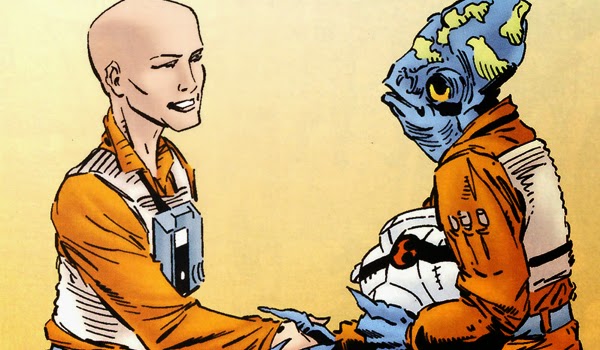
Plourr and Ibitsam, Rogue Squadron pilots.
Given that "Rogue One's" main character will be played by Felicity Jones, I suppose it's unlikely that Wedge Antilles, Hobbie Kilvan, and Wes Janson will make a return for this movie, and that's certainly a disappointing prospect.  However, I'll be even more disappointed if the Rogues in this movie turn out to be lackluster and expendable characters save for the inner circle of aces (the talented daredevil, the one with a dark past, and the practical joker -- one of whom will die at a critical point in the plot).

While it's necessary for some characters to be cannon fodder, I sincerely hope that this movie won't fall into the red shirt trap and will instead follow suit after the X-Wing series.  Reading those novels, you feel every pilot's death, because whether or not a character was doomed for destruction from the beginning, he or she was still a fully-fledged member of the squadron.  The cry of "I've been hit!" is a gut-wrenching occurrence in the text -- for both the characters and for the reader.  Some of the more recent Star Wars novels (see New Jedi Order) lost that reality and simply filled cockpits with faceless characters and sometimes nameless call signs.  In fairness, the focus of those novels was really on the philosophy of the Force, the grotesque biotechnology of the Yuuzhan Vong, and the development of the surviving Jedi who made up the ranks of the Order, so the lack of detail is somewhat forgivable.  Since "Rogue One," on the other hand, will be exclusively about pilots in X-Wing cockpits, camaraderie amongst the squad and significant elements of each character's backstory will be crucial elements in establishing a believable group of elite flying aces.

Story


I'm not going to fool myself into hoping that any of Stackpole or Allston's stories from the X-Wing series might be retrofitted for this movie.  No doubt "Rogue One" will be a new story written to suit the big screen.  Sure, I'd love to see a film rendition of the Rogues retaking Courascant from the Empire and defeating Ysanne Isard, but that's simply not going to happen.  In that regard, what I hope is not that Chris Weitz borrows plot elements from the novels, but rather that he employs the integral storytelling pieces that Stackpole and Allston introduced to the Star Wars universe: things like the reality of space warfare -- what it's like for pilots to worry about fuel and resources, to practice snubfighter tactics, to mourn lost comrades; things like the intricacies of military politics, large-scale tactical offensives, and even biological warfare; things like unique alien races whose cultural and personal backgrounds are as rich as their anatomies (see Ooryl Qrgg, Elassar Targon, and Nawara Ven).

At the same time all the adventure, humor, and excitement that define the Star Wars saga is in the X-Wing series, there is also an element of gritty reality: these are men and women who have banded together, fighting for survival as well as the greater good.

I'm not asking for "mature" Star Wars.

I'm asking for Star Wars that takes itself seriously.

~*~

Since I'm a nerd, I care about these kinds of things.  But let me wrap this up by landing on just one emotion for now.  I'm excited about this new movie.  I really am.  I'm sure there will be things that I dislike.  I'm equally sure there will be things that I find really, really cool.  The bottom line is that I want to be open-minded and thrilled -- just like any other fan of Star Wars does.  I think Disney and their crew of writers, directors, and actors are all well-aware that a significant portion of the Star Wars fan base is dying to be impressed.  Being more than just casual fans themselves, they collectively want to deliver quality additions to the saga.

For that reason, I can let myself feel a little excitement.


If you're interested in Rogue Squadron, below are some quality articles you can check out for additional background reading.  I also recommend X-Wing: Rogue Squadron by Michael A. Stackpole, the one that got this whole thing off the ground.


19 February 2015

Reviews, Part 5

Part 1 -- Part 2 -- Part 3 -- Part 4 -- Part 6 -- Part 7 -- Part 8 -- Part 9
______________________________________________________

Next on the playlist!

Here are the album reviews I've written since this past September.  Clicking on the album covers will take you to the band's music where you can listen to and/or download the album in full.  The hyperlinks will take you to my reviews.

Let me know what you think!

~*~

Engineers - Always Returning (UK)

Always Returning is a multi-faceted, philosophical puzzle with enough musical textures to keep both fans and musicians listening.
iamthemorning - Belighted (Russia)

The combination of Gleb’s classical approach to composition with Marjana’s singing ability produces bold, melodic pieces that are distinctly modern, yet extraordinarily mature.  Belighted is one of 2014’s must-purchase albums, from one of the decade’s bands to watch.


 The Phil and John Show - Cover Art (Canada)

Phil Naro is a prolific and diverse songwriter with a powerful set of pipes, and is continually finding new avenues for his creativity to expand.
KINGs - KINGs EP (Canada)

Phil Naro is a prolific and diverse songwriter with a powerful set of pipes, and is continually finding new avenues for his creativity to expand.

Bishop Reilly - Bishop Reilly (USA)

Bishop Reilly is a mature offering from a pair of musicians with a lot of experience behind them.  Their music is a conjunction of folk, blues, and rock: a vehicle for stories that connect to the human heart.